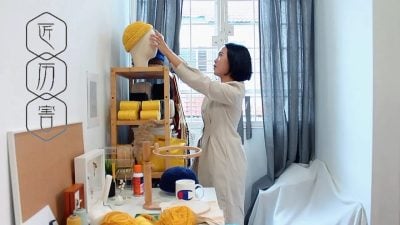

For Naz Manterang, a fashion designer from Kuching, Sarawak, clothing is more than just fabric and tailoring; it is a medium continuing a culture.
True preservation is not about locking tradition away in a museum, but weaving it into the fabric of daily life today.
Only when culture is understood and reinterpreted can it move forward through changing times and be successfully passed down to the next generation.
From dancer to costume designer
Naz was once a senior dancer with the National Academy of Arts, Culture and Heritage (ASWARA). Today, he designs costumes for performance troupes.
Rather than chasing the trends of fast fashion, he is captivated by integrating Malaysia’s multi-ethnic traditional attire into modern design.
Through precise cuts, textures, and layering, he custom-creates performance outfits for theatre actors and dancers that carry profound cultural memories.
“Clothing expresses an attitude and ethnic costumes tell a story,” Naz says.
In his eyes, Malaysia’s multiculturalism is not an abstract concept, but a tangible, wearable, and living language open to reinterpretation.
Through his craft, he hopes to give traditional attire from various ethnicities an innovative new look—ensuring it is seen, remembered, and gently kept alive.
A passion for collecting and researching ethnic garments
Stepping into his studio in Petaling Jaya, the space is modest but impeccably organised. Natural light streams through floor-to-ceiling windows into the far corner, illuminating rows of clothes racks filled with the traditional attire of the Chinese, Malay, Indian, Iban, Murut, Bidayuh, and other East Malaysian indigenous communities.
The studio feels less like a workshop and more like a miniature cultural museum—the very birthplace of his creative inspiration.
Whenever he encounters an exceptionally designed piece of ethnic clothing, he cannot resist collecting it for study.
His collection even includes family wedding attire—the traditional, vibrant red Chinese bridal gown and groom’s jacket worn by his sister and Chinese brother-in-law.

“The bridal gown with phoenix embroidery symbolises female elegance and power, while the groom’s jacket represents male nobility and authority,” Naz explains.
The dragon and phoenix featured on the gown complement each other, symbolising a harmonious and fulfilling marriage.
He particularly admires the cultural language formed by these symbolic relationships. Even if a piece is not his own creation, it serves as a vital source for his understanding of tradition and remains one of his most cherished collectibles.
Recreating outfits for the stage
When Naz finds uniquely designed traditional garments on the market, he buys them to deconstruct their elements and details. Once he grasps the cultural context, he begins his process of “secondary creation.”
He showcases a traditional bark vest from Sabah’s Murut tribe. While rustic and raw, it was impractical for stage performances.
To adapt it, he reinterpreted the vest using white neoprene and hand-stitched tribal totems with silver beads, striking a balance between modern flair and cultural significance.
When discussing traditional Malay attire, he speaks with fluent expertise: “This is the Baju Sikap from Melaka. The outer jacket uses Songket woven fabric, usually paired with a Tanjak headgear and a sash.”
Enchanted by the cross-cultural charm of the Kebaya
Naz is also deeply fascinated by the Kebaya, a traditional garment widely worn across Southeast Asia that represents a beautiful cross-cultural intersection. Influenced early on by Arab and Indian cultures, the Kebaya later integrated Chinese embroidery techniques, the lace accents and tailored silhouettes brought by European colonial eras. Over time, it evolved into a rich, diverse “Kebaya family tree,” mirroring the multicultural fusion unique to Malaysia and Southeast Asia.
In terms of materials, he prefers chiffon and lace, which add a lighter, more ethereal layering effect when the dancers move.
Traditional headpieces bearing ethnic faiths
In a corner of the studio, traditional headpieces from various ethnicities are on display, each carrying the lifestyle and beliefs of its community. Naz frequently brings these onto the stage for dancers to wear during performances.

Among them is the Lalandau, a Murut headpiece with a distinct split structure, commonly seen in crucial tribal rituals and weddings. Male dancers wear feather embellishments, symbolising courage, strength, status, and the warrior spirit.
Another striking piece is the Ra’ung hat from the Bidayuh community of Serian, Sarawak. It features a slender, cylindrical shape woven from bamboo strips and decorated with natural dyes. Simple yet highly recognisable, it remains an indispensable cultural symbol in festivals and major ceremonies to this day.
These collections bear witness to his journey over the past decade—stepping into diverse cultures and understanding them.
A multicultural upbringing roots an artistic dream
The 33-year-old designer’s upbringing is deeply rooted in multiculturalism. Born to a Malay father and a Bidayuh mother, growing up in a cultural melting pot gave him an innate sensitivity and affinity for ethnic aesthetics.
During his school years, he was never particularly interested in mathematics or science, often doodling secretly in class. He chuckles, recalling: “Even during exams, once I finished answering the questions, I would pass the remaining time by sketching all over the test paper.”

Though his life’s direction wasn’t clear back then, looking back, the seeds of art had already been sown.
Trading fashion design for dance due to tuition fees
After graduating from secondary school, Naz initially wanted to pursue fashion design. However, high tuition fees made it unfeasible. He chose to study dance at ASWARA instead, as it was the closest alternative to his artistic passions.
Upon graduation, he joined the cultural department of Kuala Lumpur City Hall (DBKL) as a professional dancer, immersing himself in the traditional dances and performance languages of various ethnic groups.
His experience as a dancer reignited his passion for design.
He began taking on costume design work and officially transitioned into a full-time designer in 2020.
At the time, he was one of three costume staff members catering to a team of about 60 dancers and two makeup artists—a role he thoroughly enjoyed.

Design enlightenment: Watching his mother sew
Naz’s earliest design inspiration came from his mother.
“She never intentionally taught me, but since childhood, I watched her sew clothes for her customers, completing them stitch by stitch,” he recalls.
These everyday moments formed the foundation of his understanding of fabrics and craftsmanship.
For over a decade, he has lived and worked in Selangor, spending most of his time hunched over his worktable drawing sketches.
His walls are covered with custom design blueprints for dancers.
Before diving into the actual sewing, he communicates extensively with choreographers to understand the narrative behind each dance, ensuring the costumes align perfectly with the context and structure of the story.
Fieldwork to deepen cultural understanding
In Naz’s view, design is never just about whether an outfit looks “good” or “glamorous.” It requires a profound understanding of the cultural context.
To ensure this, he personally conducts fieldwork to delve into the history and background of the costumes, ensuring every design has a meaningful context and foundation.
To him, design is more than just creation—it is a profound form of respect for ethnic cultures.
A childhood curiosity about cultural diversity
Growing up in Borneo, Naz was exposed to diverse ethnic groups like the Iban, Bidayuh, Orang Ulu, and Melanau, sparking an early curiosity about cultural differences.

He recalls witnessing the Melanau community perform the Alu-Alu dance during funeral wakes. The dancers mostly wore black adorned with subtle jewelry, presenting a solemn yet layered aesthetic. In contrast, they donned vibrant attire during festive celebrations, making the dance incredibly infectious.
“We are very fortunate as Malaysians; we have so many fascinating cultures to explore,’’ he said.
Adapting traditional costumes for the modern stage
Naz believes that traditional attire must be adjusted to fit the context of modern staging.
“I am not trying to alter tradition, but if we don’t look toward the future, we won’t be able to safeguard it,” he says.
Using the Kebaya as an example, he incorporated a trouser structure into his designs, allowing dancers to execute wide, dramatic movements while preserving the garment’s cultural essence.
He has also experimented with blending streetwear elements into traditional designs. For instance, he styled host and content creator Daniel Cheang by reinterpreting the traditional Pua Kumbu totems of the Iban community using a minimalist black-and-white palette. Combined with streetwear aesthetics, this ethnic pattern successfully graced the international stage at the premiere of Avatar: Fire and Ash.
From understanding and appreciation to preservation
Over the years, Naz’s understanding of local multi-ethnic cultures has evolved from pure appreciation to deep reverence.
“The more you understand a culture, the more you cherish it, and the more you want to protect it. You don’t want it to be forgotten or become unrecognisable as it is passed down,’’ he said.
He remains optimistic even as the younger generation is increasingly drawn to pop culture. He believes change is already happening, noting that creators like Mimi Fly are also trying to reinterpret tradition through music and visual language, making traditional culture much more relatable to the contemporary world.

ADVERTISEMENT
ADVERTISEMENT