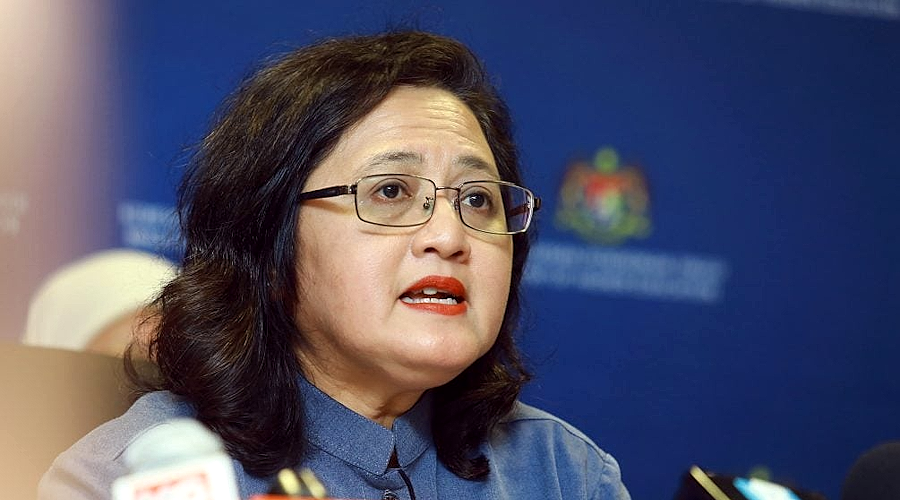
PUTRAJAYA: Local students remain the top priority in terms of placement in public universities says Prof Datuk Dr Azlinda Azman, the director-general of Higher Education Ministry.
Dismissing claims that local students are sidelined, she said the education politics for undergraduates and postgraduates are entirely different and the data should not be lumped together due to differences in policy.
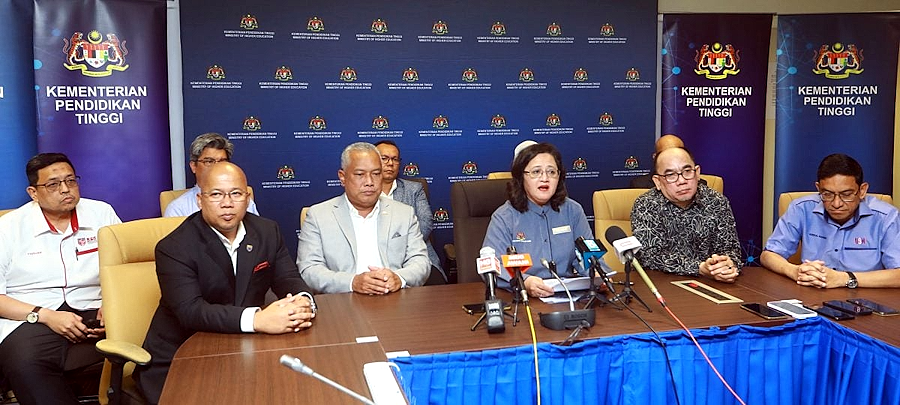
At a press conference held at the Ministry of Higher Education, accompanied by seven public university vice-chancellors and the Chief Executive Officer of the Malaysian Qualifications Agency (MQA), Prof. Datuk Dr. Mohammad Shatar Sabran, Dr Azlinda strongly refuted misleading remarks recently made by Kedah state executive councilor Professor Dr. Haim Hilman Abdullah on international student policies.
The policy to internationalize higher education has not undermined opportunities for local students, said Dr Azlinda.
Current data clearly shows that in the five research universities, 78.7 percent of students are locals, while international students make up only 21.3 percent.
“According to Ministry statistics up to 31 December 2024, the total student population in five research universities—Universiti Malaya (UM), Universiti Kebangsaan Malaysia (UKM), Universiti Putra Malaysia (UPM), Universiti Sains Malaysia (USM) and Universiti Teknologi Malaysia (UTM)—is 180,024.
“Of these, 141,636 are local students, while 38,388 (21.3 percent) are international students, across both undergraduate and postgraduate levels,” she said.
However, at the undergraduate level—which includes certificate, diploma, and bachelor’s programs—seats are limited and prioritized for locals.
Currently, local students account for 91.6 percent of undergraduates in the five research universities, while international students make up only 8.4 percent.
In addition, most undergraduates benefit from government subsidies, which are only given to locals, she said.
At the postgraduate level, Dr Azlinda said the ministry adopts an open policy to actively promote internationalization, allowing universities to recruit international students which also helps improve global rankings.
“For example, UM is currently ranked 58th in the QS World University Rankings, while the other four research universities rank between 126th and 153th.
“Within ASEAN, all five are among the top 10, reflecting the high quality of Malaysian higher education,” she said.
Dr Azlinda clarified that international students pay full tuition fees and do not receive government subsidies, hence there is no conflict of interest with local students.
On the ratio of international students, she said this varies by university depending on staff capacity and enrollment ability, as well as the range of courses offered.
“Postgraduate programs usually depend on the specialized fields of the university. When choosing where to study, students look for suitable supervisors.
“Postgraduate students spend less time on campus as they need to conduct research outside. Most postgraduate programs offered by the universities are research-based rather than coursework-based,” she said.
UM Vice-Chancellor Prof Datuk Seri Dr Noor Azuan Abu Osman added that overall, the number of local students still far exceeds international students.
Sultan Idris Education University Vice-Chancellor Prof. Datuk Dr. Md Amin Md Taff stated that for postgraduate studies such as master’s and PhD, universities generally do not set quotas for locals or internationals; they prioritize the best talent and usually favor local applicants.
Dr Azlinda criticized the state executive councilor—a former public university vice-chancellor—for repeatedly making inaccurate public statements, including quoting wrong data in the state assembly, which misled the public and created misconceptions on social media.
At the press conference, without naming Dr Haim, she referred him as “the state executive councilor.”
Dr Azlinda also expressed her dismay over the action by the state executive councilor given his experience as a former vice-chancellor.
Dr Azlinda further pointed out that when the councilor was serving as a university vice-chancellor, he had proudly announced in an interview with Utusan Malaysia on 11 October 2022 that international student intake at his university had increased by 13.97 percent for the 2022/2023 academic year.
“This shows that at the time, he supported and implemented policies to recruit international students. Now he is criticizing the same policy,” she said.
“The ministry will continue to monitor international student admissions to ensure that local students always receive priority in the national higher education sector.”
Dr. Haim is one of those voicing concerns about the direct enrollment of international students in public universities where foreign students outnumber local Chinese students as they make up of 21.3 percent in five research universities while local Chinese students only 13 percent to 13.5 percent.
ADVERTISEMENT
ADVERTISEMENT