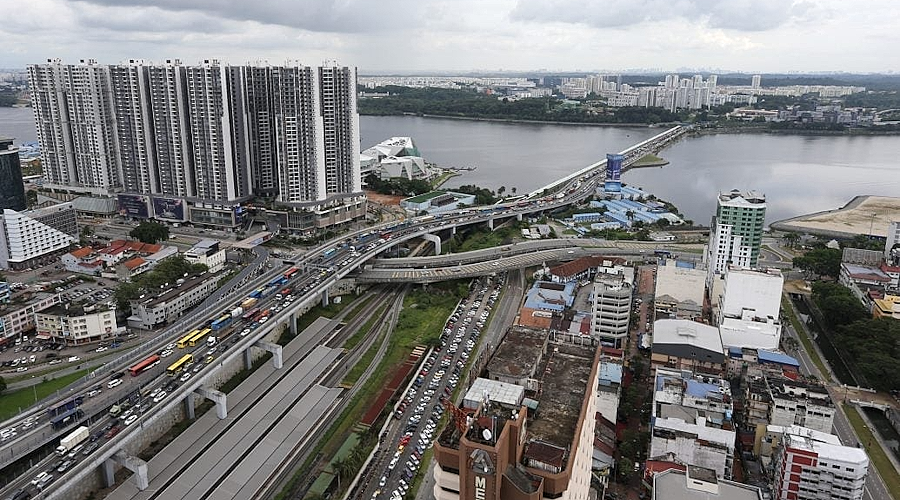
JOHOR BAHRU: Local e-hailing drivers and chartered car drivers commuting between Johor and Singapore are planning to form an association following strict enforcement carried out by the Land Transport Authority (LTA) in Singapore.
Their goal is to appeal to authorities and urge Transport Minister Loke Siew Fook to look into their plight.
Many claimed that the cross-border chartered service angered their Singaporean counterparts who began filing complaints to LTA, which prompted the latter to take actions.
The recent crackdown has had a huge impact on local drivers where some of them stopped the cross-border chartered service temporarily while those who are desperate to make a living opt to take the risk of being caught by continuing with the service.
One of them, identified as Lim, told Sin Chew Daily that documents had been submitted to the Registrar of Societies to form an association representing this group of drivers.
At least 1,000 drivers have expressed support for the association.
Lim said there are over 4,000 cross-border drivers in Johor Bahru alone.
While he acknowledged that many operators are indeed operating illegally, he also stressed that they contributed to local tourism industry.
He also said many are keen to comply with the procedures, including apply for a proper license with insurance coverage if the authorities provide a legitimate pathway.
Citing the example of Transport Ministry legalizing e-hailing services, he said the ministry introduced series of measures requiring e-hailing companies to provide drivers training and insurance coverage. Both drivers and passengers are protected.
Lim believes the authorities can adopt a similar approach to gradually legalize cross-border transport services before acting for Malaysian drivers to negotiate with Singapore to resolve the issues.
“Once the cross-border transport service is legalized, then we can negotiate with Singapore. The purpose of forming the association is to gather feedback and collective strength to negotiate with the relevant ministries and accelerate the implementation of favorable and friendly policies,” he said.
So far, Loke had not commented on the enforcement actions taken by LTA.
Lim hopes that Loke will visit Johor Bahru to listen to the drivers who provide cross-border transport services.
A tour guide identified as Lee, also supports the formation of the association.
Due to the nature of his job, Lee said he had been commuting to airport to pick up and send off passengers traveling on business trips to factories, offices and hotels.
With documents provided by the company, Lim said he made an average of 150 trips per month.
Lee said he had documents provided by the company to pick up and send off passengers but the enforcement caused delays, leaving a poor impression on foreign VIPs and damaging the company’s reputation.
Instead of Changi Airport, he feared that the passengers might start flying in and out of Kuala Lumpur International Airport.
He said that cross-border transport services between Malaysia and Singapore have existed for decades.
The only way to solve the current problem is to legalize the service, which requires government intervention and cooperation.
Therefore, he sees forming an association as the only way to get the authorities’ attention.
“We hope that through the association, we can meet with Transport Minister Anthony Loke and Johor Menter Besar Datuk Onn Hafiz Ghazito present our ideas to them,” he said.
On the other hand, some operators are skeptical of the association and have refused to join, even though they face the same difficulties.
The crackdown by LTA on cross-border transport is not a new issue. A driver was caught several times over seven years, with the fourth incident happening during the latest enforcement.
Lee, a driver with about 15 years of cross-border experience, revealed that he has been detained by enforcement officers four times since 2017.
He explained that he would support it if Singapore legalized one-way trips, but he believes that any policy change would likely come with two major problems: higher fares (e.g., from S100 (RM329) to S130 (RM428)) and increasingly severe traffic congestion at the Malaysia-Singapore checkpoints.
“To avoid risk, I generally don’t take guests into Singapore now. If a customer insists on paying, I will refer them to a Singapore-registered fleet,” he said.
Another driver with over 20 years of experience, who goes by the pseudonym Louis, has no confidence in the association and will not join.
He has a formal contract with a factory and his employees have work passes. Louis also transports senior executives and foreign clients as part of his job.
However, he mentioned that a driver who was transporting a foreign VIP for a contract signing was recently taken away by enforcement officers because the trip involved Singapore and the VIP could not be contacted for a short time.
“This incident did not only seriously affect the factory’s supply chain operations, company reputation, and business dealings but also led to speculation that we were involved in human trafficking,” he said.
Louis emphasized that they are not “illegal taxis” stealing tourists’ business and he supports the authorities in cracking down on non-compliant drivers.
However, he hopes the authorities will differentiate between legal and illegal charter services.
“The authorities should also be more transparent and make the legal provisions for cross-border transport public, providing clear guidelines for operators,” he said.

ADVERTISEMENT
ADVERTISEMENT